
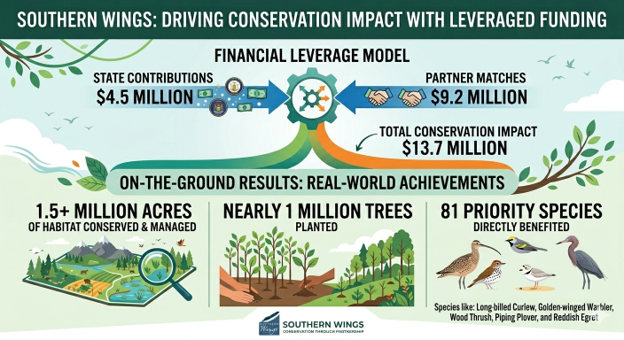
When state fish and wildlife agencies invest millions of dollars into breeding habitat restoration, nest monitoring, and local land conservation, they are doing vital stewardship work. But for Neotropical migratory species—like the Wood Thrush, Cerulean Warbler, and Bobolink—in-state conservation is only half the story. If these birds face habitat loss and fragmentation on their wintering grounds in Latin America and the Caribbean, local conservation investments risk falling short. Enter Southern Wings, a science-driven, state-led initiative that enables agencies to conserve their migratory species across their full annual cycle—much like states have successfully done for waterfowl in Canada for decades. The 25% Challenge: Securing the Full Annual Cycle To maintain momentum and scale hemispheric conservation, Southern Wings has issued the 25% Challenge: The Goal: Reach at least 25% of your state’s annual Southern Wings investment goal, or increase your agency's contribution by 25% this year. Collective Target: Reaching a collective $2M annual investment. States who step up to meet or exceed the challenge will be formally recognized during the Southern Wings Achievement Awards Luncheon at the upcoming AFWA Annual Meeting. The Economic Return on Investment (ROI) Beyond biological stewardship, conserving migratory birds directly safeguards state outdoor economies. Birds are massive economic drivers: Ohio: Home to 3.5 million birdwatchers (ranking #7 nationally). With 91% of the state’s 4.1 million wildlife viewers seeking birds, birding generates $1.6 billion annually in local economic impact. Minnesota: Home to nearly 1.8 million birdwatchers. Overall, wildlife watchers generated $5.0 billion in spending in 2022. This economic activity relies heavily on birds returning to our backyards and natural areas each spring. Join the Challenge Whether your agency is looking to join Southern Wings for the first time or expand its current participation, your contribution directly protects your state’s biological heritage and economic investments. To learn more about your state's specific investment goal or to discuss partnership opportunities, reach out to Deb Hahn or Bradley Wilkinson .

Ohio Division of Wildlife shares 2025 review and what's to come in 2026 (PDF)
Mystery solved: Elusive cougar cubs documented again in Michigan Posted on December 18, 2025 , by admin Nine months after two cougar kittens were documented in the Upper Peninsula, a new trail camera photo indicates the elusive animals are still alive and living with their mother. Michigan DNR News Dec. 18, 2025 Contact: Brian Roell , DNR biologist The Michigan Department of Natural Resources verified the Dec. 6 photo of an adult cougar being followed by two kittens down a snowy trail in central Ontonagon County. The last time the kittens were documented – in early March – they were only about two months old and their mother was nowhere in sight, raising concerns about the kittens’ survival. But the newly verified photo shows an adult cougar with two juvenile cougars that appear to be about a year old, according to Brian Roell, the DNR’s large carnivore specialist. Michigan is home to very few cougars and genetic testing has confirmed the existence of only adult males. The new photo suggests one of the first instances of cougar reproduction to take place outside the cougars’ core area in the Western states. “This is a historic confirmation for Michigan since it is the first time in over 100 years that verified cougar reproduction has occurred east of the Mississippi River and possible even east of the Missouri River,” Roell said. A private landowner sent the trail camera photo of the cougars to the DNR on Sunday, Dec. 14. Roell verified the site of the photo Monday and the DNR’s cougar team confirmed the photo Tuesday by enhancing the nighttime image to verify the existence of the three cougars. The sex of the kittens is unknown. Cougar kittens, or cubs, generally stay with their mother for about two years before venturing out on their own. “The kittens’ chances of survival are actually pretty high because just like bears, cougars invest a lot of their energy into their young,” Roell said. “So these kittens will stay with their mom through this winter and possibly even into next winter. They already have a leg up, seeing as how they’ve been with her for a year now.” Roell is surprised the cougar kittens weren’t documented from any public or private trail cameras since March. The DNR operates more than 1,300 trail cameras in the U.P. to survey wildlife abundance. “The interesting thing is, where were they for nine months?” Roell says. “That’s a mystery.” Native to Michigan, cougars were essentially hunted out of the state by the early 1900s. Since 2008, the DNR has confirmed about 168 cougar sightings, all in the U.P., although most of those sightings are of the same animal being reported by multiple sources, Roell said. Cougar sightings have increased each year since 2019, Roell added, but the number of trail cameras has also increased. Cougar sightings on DNR-operated cameras accounted for more than 25% of the verified cougar sightings in 2024. Visit the DNR’s cougar dashboard and cougar photo page for more information. In addition to the cougar kittens in Michigan, there have been more cougars reported in other areas, including Nebraska. However, cougars need vast territories because they are solitary ambush predators that rely on deer and other large prey, which leads to low population densities. Even states with the largest cougar populations generally have just a few thousand of the animals. “This isn’t an animal that is ever going to become very numerous,” Roell said. “They’re going to remain rare on the landscape regardless of whatever happens with them here in Michigan.” Cougars are on the list of endangered mammals in Michigan, meaning it’s illegal to hunt or harass them, which includes trying to locate their den on public or private property. “Too much human pressure can also trigger the female cougar to abandon her cubs,” Roell said. “As with all wild animals, we’re asking the public to respect their habitat and allow them to live naturally in their home.”
